The Questions Underneath
Seventeen years of questions, and the one that was underneath all along.

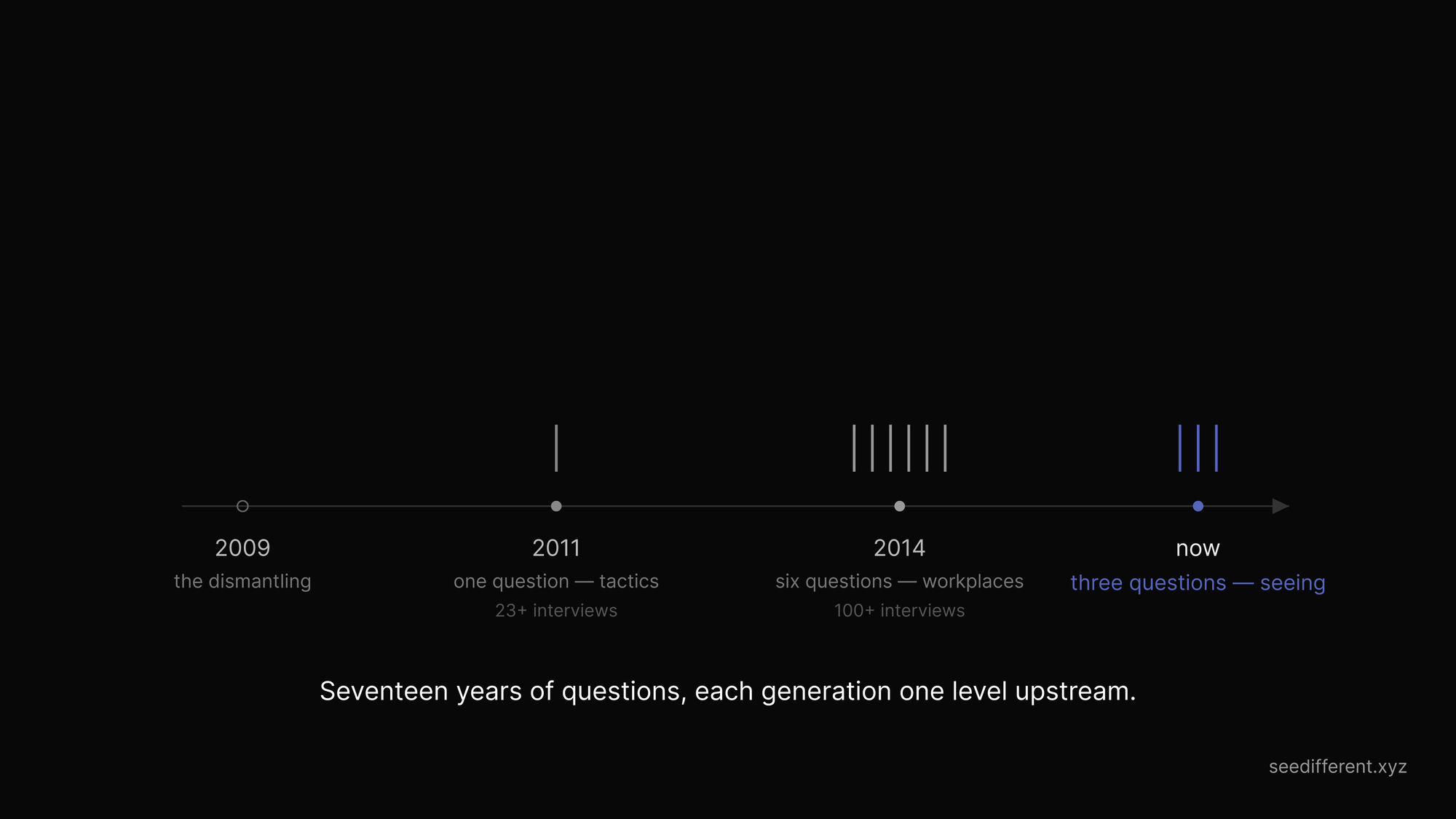
In 2009 I watched a new executive dismantle two years of work in a matter of weeks. Initiatives that were alive one month were gone the next. I had seen it occur repeatedly for the past two decades. So I did the only thing I could think of. I resigned and started asking questions.
I asked the question I had. Process improvement had been my most recent focus, and so a year or so later I launched an interview series called 5 Minutes to Process Improvement Success and asked experts a single question:
“What is your best process improvement strategy or tactic that has worked really well for you or your clients?”
Tactics. Techniques. Five minutes. I was asking for tools, because tools were what I thought was missing.
The answers went beyond process, beginning with the very first. Karen Base opened the series by saying yes, it’s about process improvement, but mostly it’s about establishing trust, about being respectful of the status quo. Scott Ambler’s best strategy was helping people become aware of what they’re actually doing.
Paul McMahon said he’d learned not to give clients answers. Jeff Dalton said the hardest part isn’t telling clients what to do. That’s not even part of the work. Mary Lynn Penn’s was listening. Dale Emery’s best tactic was asking questions. And Carson Holmes challenged the title itself. He challenged the false promise of success in five minutes before he would answer at all.
I asked about process and people answered about people.
By early 2012 there were twenty-three interviews, and the record shows me noticing something interesting. In the middle of the Dale Emery conversation I say that I’m always surprised by what comes out when I ask this question. It seems to cause a reflection that surprises us both. The question about tactics wasn’t collecting tactics. It was already doing something else, to the guests and to me.
In 2014 I ended the series, because it was never about process improvement.
What it was about became Forward Thinking Workplaces. A forum for more than a hundred conversations built on six new questions:
- How can we create workplaces where every voice is heard and matters, everyone thrives and finds meaning, and change and innovation happen naturally?
- What does it take to get an employee’s full attention and best performance?
- What do people really lack and long for at work?
- What is the most important question leaders should ask employees?
- What is the most important question employees should ask leaders?
- What is the most important question we should ask ourselves?
I thought I had finally found the right questions.
But rereading the questions now, I can see something else was going on. The questions never asked anyone for an opinion. They asked what it takes. What people long for. What we should ask.
Every one of them assumed the answer lived in the person across from me, in what they had directly lived. I never argued with a single interviewee in seventeen years. There was nothing to argue with. Experience isn’t a position.
And the questions had a direction I didn’t notice while asking them. The first series asked about tactics. The six questions start at the whole workplace and end somewhere else entirely: what is the most important question we should ask ourselves? Out there to in here. I spent seventeen years walking that path one interview at a time, thinking I was studying organizations.
I was studying seeing.
Because underneath every question I ever asked is a quieter one. Attention is a perception word. Longing to matter is longing to be seen. The leader and the employee are two people looking at the same organization and seeing different ones. And the first series had been answering the deeper question before I could ask it: trust, awareness, listening, better questions. Awareness was there in Scott’s answer in 2011, waiting a decade for me to hear it as my own. The workplace was never the subject. It was the screen where everyone’s seeing became visible.
So these are the questions I can finally ask. The ones that were underneath all along:
- What are we giving our attention to and who decided?
- What do we long to have seen in us, and what stops us from seeing it in others?
- What have I already decided before I looked?
Three instead of six instead of one. Each generation of questions moved one level upstream. The last one is where they were all headed.
The executive in 2009 didn’t see what I saw. For years I held that as the problem. Now I hold it as the origin. A new executive ended two years of work in a matter of weeks. That’s what happened. The loss, the wrongness of it: that was what I laid on top.
The executive was laying something on top too. Two stories over the same events, and neither of us could see our own. I have spent everything since trying to understand how that happens, and what becomes possible when it stops.
Seventeen years of asking others.
What am I deciding before I look?
— BF